Reforms of the Reckless
On The New York Times Losing Their Minds

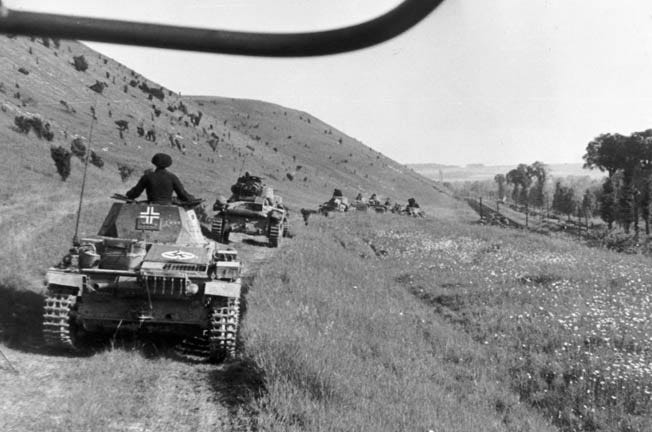
German 7th Panzer Division in the Countryside of France, 1940
I don’t know who from the New York Times Editorial Board authored this piece, but it is probably one of the single worst instances of military-related writing I have seen in my adult life.1
It is so filled with incomprehensible claims and historically illiterate comparisons that you’d be forgiven if you thought the writer of this piece had just finished their first game of Heart of Iron 4.
The foundational thrust of the piece relies upon a claim that America’s military has grown weak and brittle through decades of procuring expensive and overengineered weapons systems, while our adversaries have invested in cheap and plentiful options.
To start with. In the view of the NYT, the U.S. military faces a moment akin to the French army in 1940, stuck behind its defensive Maginot Line, or Russian armored formations in Ukraine in 2022, decimated by Javelin missiles.
It is a version of both conflicts that makes for a punchy line. It makes you think about how oh so dire our situation must be that we’re sleepwalking into catastrophe. It is also a completely fabricated version of how both militaries met disaster.
For anyone not versed in the history of the French Campaign in WW2, the Maginot Line never fell. In reality, the Germans executed a mechanized assault—Fall Gelb—and exploited a gap in the French lines at the Ardennes.
There has been quite a lot of ink spilled on this subject, but the French military did not capitulate due to a lack of technological sophistication, doctrinal innovation, or inattention to the lessons learned of WWI.
The problem was that the force they designed and the doctrine that accompanied it were predicated on learning the wrong lessons from WWI. They incorporated tanks (albeit without widespread adoption of radios) into their formations—but they integrated them (for the most part) as support to infantry forces rather than as an independent operational arm.
While they arguably had a superior tank force on paper, they were unable to properly utilize those forces at a decisive point and exploit a breakthrough, like the Germans were able to do.
Similarly, French doctrine—which embraced lessons from WWI—emphasized a “methodological approach” to warfare that was overwhelmingly fires-centric. It wasn’t that it was a totally poorly conceived theory of the case; it’s just that it was badly equipped to rapidly respond to the shock induced by the German mechanized maneuver.2
Furthermore, while the French Air Force was outnumbered at the beginning of the conflict, and their industry was woefully inadequate, they were defeated—again—through poor employment of their forces. The Luftwaffe was capable of concentrating force and dominating necessary sectors of the battlespace, whereas the French allowed their Air Force to be depleted through incompetent C2, leading to haphazard and uncoordinated employment.
As for the idea that the Russian military was defeated by Javelins? Are you serious, NYT? The Russian invasion of 2022 is well within living memory. This is complete nonsense, and as RUSI painstakingly documented, the Russians were turned back by a Ukrainian military using traditional fires while engaged in a high-intensity conventional fight.
The next section, however, is in the running for one of the most absurd comparisons I have ever seen by someone attempting to pass themselves off as a credible commentator:
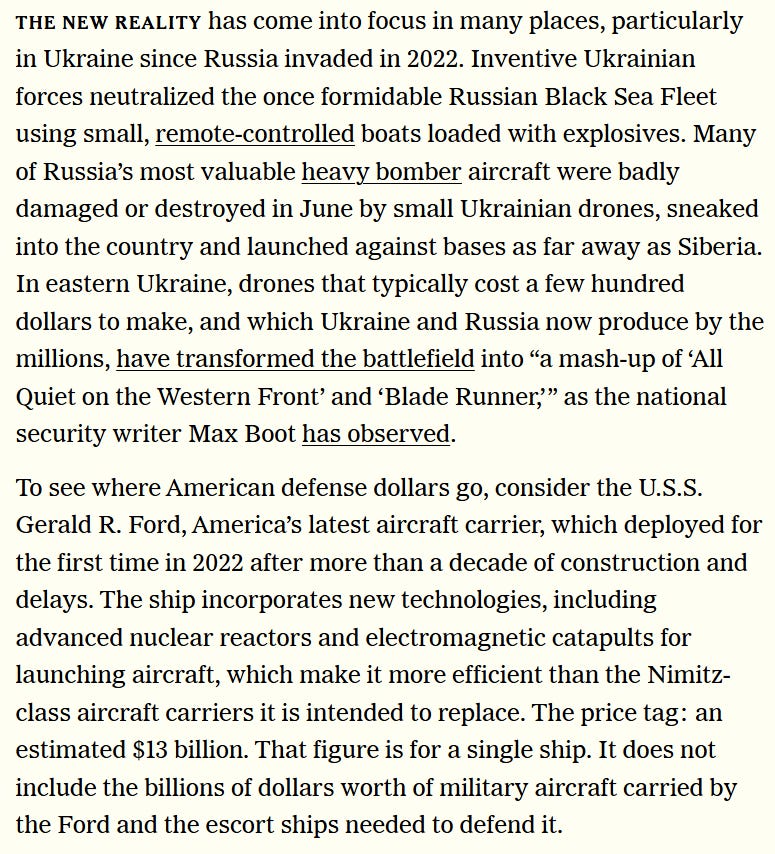
I feel like I should not have to say this, but an FPV drone and an aircraft carrier are not comparable. You can not—and I cannot believe I’m saying this—transport multiple airwings to contest sea lanes with a $100 drone. It’s like comparing a bottle of water to an aqueduct and complaining that the bottle of water costs less. What are you doing? It’s idiotic.
Especially given the context of the article itself, which is about a potential fight over Taiwan. Riddle me this, NYT, but without carriers to project power into the Taiwanese Strait, how exactly do you plan to contest a crossing in the first place?
Moreover, the implication is that because a carrier costs a lot and a carrier can also be destroyed, they are therefore poor investments. Well, someone should tell China that the NYT thinks this is a bad idea because they’re still building them.
Also, what kind of argument is this in the first place? Yeah, you can sink an aircraft carrier. I guess that’s why they became irrelevant after the Battle of Midway. For that matter, tanks also became extinct after the Battle of Kursk, I guess. It’s complete nonsense.
More importantly, what good exactly is a cheap system if it’s overmatched by the capabilities an adversary can field?
Sure, you can build a fleet that’s inexpensive, but what exactly happens when you encounter a Chinese fleet that is modernized? What exactly is the point of cruise missiles that cannot reliably reach their targets? How is it less expensive in blood and treasure to force troops into combat without the necessary protected mobility we can provide them?
Should we just go the way of the Russians and throw bodies at the Taiwanese Strait because the NYT finds the costs of high-end systems too much to manage?
The next section revolves around the NYT going into a lengthy digression on potential asymmetric capabilities that adversaries could employ in a conflict. The NYT rhetorically asks why—in an era of cyber warfare—our political class is invested in the old way of war.3
In which case, I would like to introduce the NYT to the history of warfare. You will not believe this, but doing things like targeting infrastructure in a conflict is not new, and historically speaking, it did not render conventional forces obsolete.
I would also like to take this chance to remind the NYT that a cyber-attack—while potentially harmful—does not replace the essential element of warfighting, which is actual kinetic operations that involve guns and bombs in the real world.
The next section complains about how our industrial base has atrophied in producing munitions at scale, which is actually fair enough in some respects. We don’t produce enough necessary munitions, and this has been a long-term complaint.
But this will only get fixed through investing political will into standing up more production capacity on core systems—rather than frittering away our attention span and resources on whatever new gizmo-of-the-month some Silicon Valley wunderkid pitches the DoD.
Although I’d object to the notion that producing more capable systems in fewer numbers is a poor tradeoff. I would much prefer to create one singular effective strike package that can accomplish a given task than to fire 500 cheap UAVs at a target.
The piece ends with a solemn appeal that if we continue to spend money on what the NYT deems “traditional symbols of might” at the expense of “relentless innovation and rapid adaptability,” we risk catastrophe.
But you know what actually causes catastrophe? Abusing and misunderstanding prior mistakes in history. Blindly pushing forward with an ill-conceived and vaguely defined concept of reform for the sake of reform risks the creation of a force that is poorly equipped and trained for the next fight.
I am not someone who’s opposed to reform at all. I have—and remain—a strong proponent of the Marine Corps’ FD2030. It is a well-thought-out and structured plan to create a force that can sustain a fight in the Pacific. It relies upon iterative testing and the validation of concepts through wargaming and exercises.
They’ve planned their force around how to utilize long-range fires, requirements for a survivable force, and have invested in the systems to enable Marines to find, fix, and destroy adversaries in the likely fight they’ll encounter.
It is how you engage with transforming a military force with the clarity and seriousness that it deserves.
But as for the NYT’s plan to seemingly turn the keys of the DoD over to the Palmer Luckeys of the world? They’ll actually create the conditions for the U.S. Military to recreate the French military in 1940.
I’m writing this purely out of annoyance, so I’m not going to take the time to go back and cite tons of stuff for the French in WWII. Just you know…trust me. There are plenty of great historians of WWII you can read, like Glantz, Citino, Kershaw, and Beevor. Just go read them.
I wish I could find it at the moment, but there are fascinating accounts of French officers sitting paralyzed in their operations centers during the Fall of France through sheer psychological breakdown caused by their inability to respond to how rapidly events were unfolding. Just again, trust me, bro.
The NYT also blames this on defense-industrial contractors attempting to sell the taxpayers increasingly expensive systems and platforms. Because our new heroic startups like Anduril selling a copy of Raytheon’s Coyote Block 2 for three times the price is clearly the future of effective procurement.
If the Javelin thing was actually correct it would make even less sense — 'America now in the position of someone who has just been defeated with modern American technology.'
I agree that anyone who compares Ukraine and Taiwan or drones and aircraft carriers is an idiot. But that doesn't make the denial of the changes occurring in warfare any more plausible.
Drones are a continuation of the precision revolution in warfare, bringing this precision to the platoon/squad level (due to their low cost and mass production). This is a change on the same scale as the changes of the 1970s.
This radically changes warfare, but it doesn't mean that old systems have become irrelevant. Rather, the problem is that this development is reorganizing the battlefield in such a way that even regular troops are beginning to use methods previously reserved for guerrillas.
Obviously, this is radically disadvantageous for powerful players like America—because it pushes them out of the comfortable bubble of destroying the enemy with superior forces through rapid maneuvers, essentially into a permanent counterinsurgency operation, but one that occurs across the entire front line.
America has lost every counterinsurgency war it has waged in recent history. Remember the impact IEDs had on combat tactics and doctrine in Iraq and Afghanistan, and the shock they caused. Now imagine flying IEDs.
>It's just that it was poorly equipped to rapidly respond to the shock induced by the German mechanized maneuver.
It's precisely the shock that will be caused when the current American army clashes with an enemy that has truly mastered drone warfare. The same feeling the French felt when they simply couldn't understand how the enemy appeared behind them will be felt by any army that faces an enemy that has mastered drone warfare.
Although I must say right away that I highly doubt China understands drone warfare—they're more likely to be cosplaying.