The Emerging American Achilles
Violence Without the Law

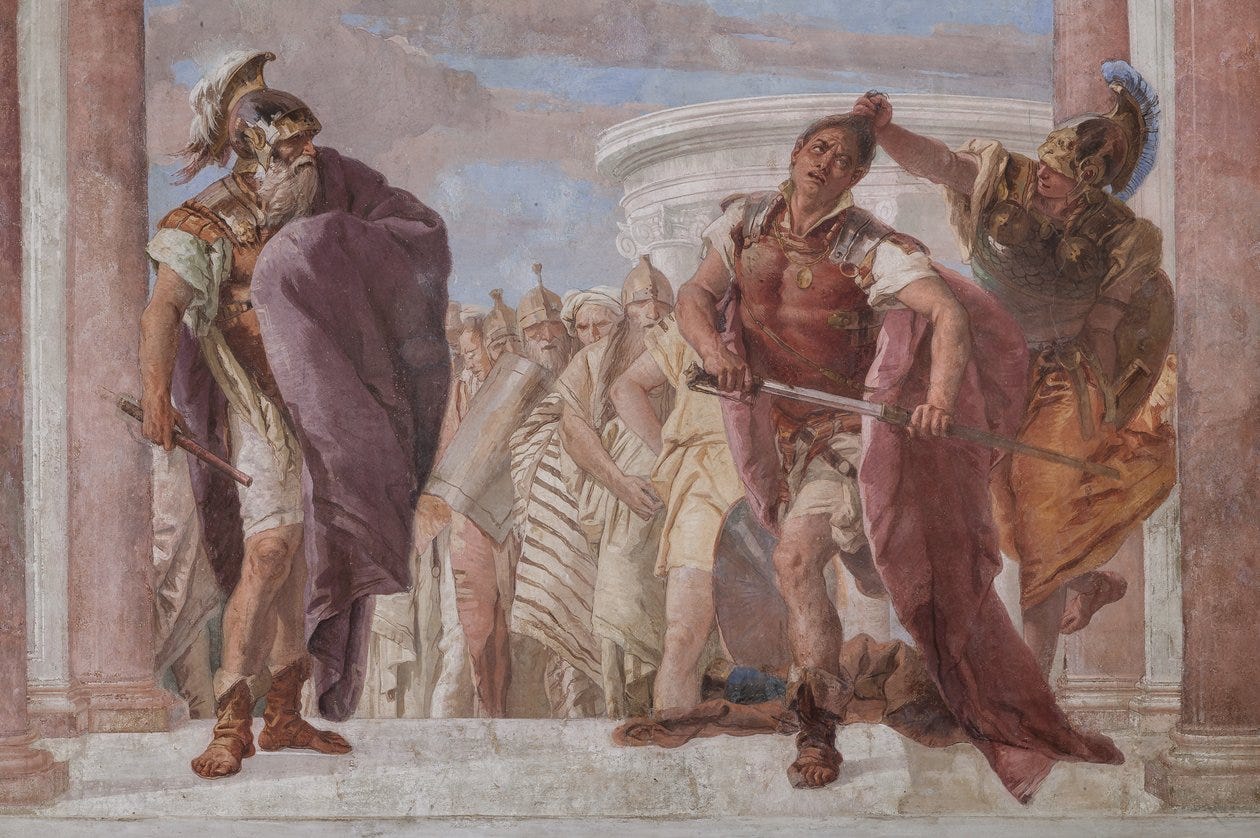
Athena prevents Achilles from drawing his sword against Agamemnon, Giovanni-Battista Tiepolo, 1757
When we think of war, we tend to think of the cruelty involved. In popular consciousness, we envision war as an activity that consists only of the butchery of an opposing force. Pundits are often all too happy to feed that perception by repeating mantras about how, if only the military could fight with less restraint, our wars would turn out differently.
But war is not murder. It is not the domain of psychopaths and criminals.
There is a difference between killing a man in an alleyway for his wallet and fighting an enemy in a conflict.
Armed conflict—as a construct—recognizes that the combatants involved are human beings.
When we engage in killing in war, it is meant to be done with an understanding that those opposed to us still retain an inherent dignity that ought to be respected. We constrain what we do by showing deference to laws and norms.
When a combatant surrenders, they are out of the fight. When someone is gravely wounded, we render them aid. When someone is shipwrecked, we rescue them.
We do this for our own sake as much as theirs.1
What worth would I have as a person if I were willing to kill an injured combatant? Who are we as a Nation if we condone the executions of men who are out of the fight? What does it say about any of us if we’re willing to violate protections that combatants have enjoyed since the earliest recorded conflicts?
What, in fact, would I not be willing to do if I were willing to transgress our most basic rules?
One of the most persistent themes throughout the Iliad is the gradual degeneration of the norms surrounding the treatment of combatants by the Greeks and the Trojans.
When the poem begins, the Trojans and Greeks both accept the surrenders of their enemies, even going as far as to exchange armor and war stories with one another.
Despite being engaged in conflict, the combatants retain their basic understanding of the opposing parties as human beings.
However, as the muses take note, the Iliad is a story of rage.
As the war carries on, surrenders turn into massacres. Proper funeral rites degenerate into the desecration of Hector’s corpse. The culmination of the bloodletting revolves around the revolt of nature itself against the slaughter inflicted by Achilles. Earthquakes shake the Trojan fields, and the river-god Scamander revolts against the blood and bodies that pollute his once clean stream.
When the city falls—the Greeks massacre everyone inside, including the infant child of Hector.
It is a tale—in part—of the disintegration of the Greek army. We are told, often, that they are the best of the Greeks.2
But the heroes of Homer all go on, without exception, to meet sadness and misfortune.
Ajax is driven insane by the slaughter. Agamemnon is murdered by his wife upon his return to Greece. Achilles laments that if he could have chosen again—he would have much preferred a long life as a simple man.
Odysseus, in particular, is described as a man who knew suffering and pain greater than any other individual. For him, violence stalks him home to Ithica. The perpetual bloodshed that Odysseus encounters only ends with the divine intervention of Athena—not because he was capable of escaping it himself.
The heroes of Homer—and by extension the social class they represent—all go on, without exception, to meet sadness and misfortune.3
We ought not to accept the same becoming of us.
The military is not a separate organ outside of the broader political community. The military is drawn from the entirety of our country and is a reflection of ourselves. If we agree to allow those in uniform to commit heinous acts—we degrade our own sense of self just as much as those in the military do.
The morality that holds in our military cannot be different from the values that sustain our political community writ large.
We cannot maintain a democratic system of governance if we accept a military that acts outside the strictures of the law.
If a combatant commander cultivates an atmosphere where laws are mere suggestions—why should that only apply overseas? What would make you believe that one breach of norms would not become another? What would make those soldiers act within the law in the rest of their lives?
When an act is considered just or unjust at the sole discretion of one individual, what would give you the impression that that person has the discernment to never make those choices domestically?
How can a people who call themselves a democratic people that live in a Nation of laws continue itself when we permit a segment of our society to operate outside of our laws?
It isn’t just that the murder of protected combatants is wrong in itself—it is—it’s that we’re allowing the sort of behavior that hollows out what it means to be a member of a political community.
Caesar broke the laws of Rome in Gaul well before he ever marched on the city itself. What would make you think we’re immune?
I realize Phil Klay already wrote something similar to this, but well, you know. I’m also allowed to care about the societal effect that committing war crimes has on our body politic.
Except Nestor. All he does is complain about how the kids aren’t as good as they were back in his day.
Well, except Menelaus. Kind of. It’s sort of heavily implied that Helen is drugging herself to deal with the fate of her life.
Odysseus doesn't even escape, he is killed when Telegonus (his son by Circe) arrives at Ithaca and he charges out at his son in a rage. The effects of the Trojan War pass down generations (which also supports your argument!).
That's what eternal GWOT had done to American society.
It had done to Russian society with Chechnya
It had done to Iranian society with Syria
It had done to Pakistani society with Afghanistan
The only way out sometimes seemed to be... Losing foreign wars.
Losing Vietnam did more good for American democracy than everything between 1945-1968 combined